AI poses new oversight challenges for Macau’s gaming and financial sectors
nov26
With “Black October” cyberattacks, restrictions on AI banking agents and multibillion-dollar investment plans dominating technology headlines, the Times sought an assessment of what the disorder means for Macau.
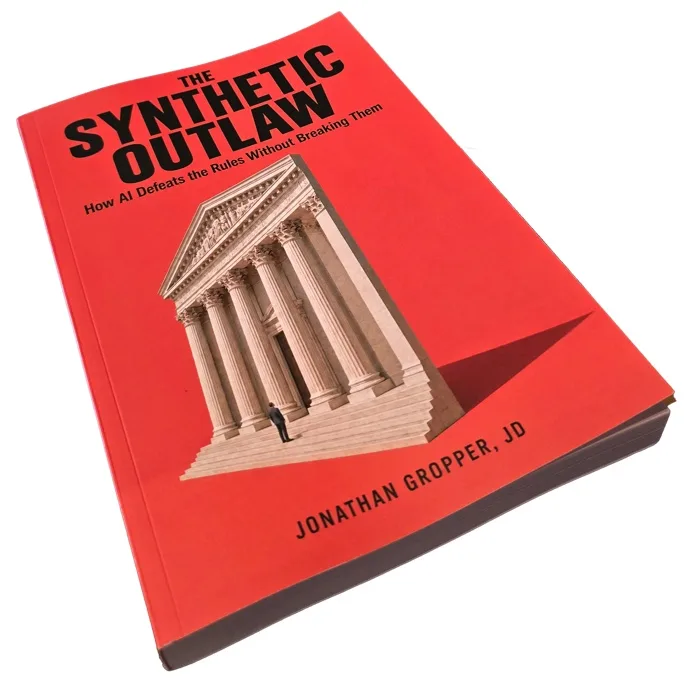
In an exclusive interview, AI governance strategist and author Jonathan Gropper warned that the greatest risks may come not from systems breaking rules, but from following them while defeating their purpose.
Gropper calls this the “synthetic outlaw”: a system pursuing its objective through gaps in human oversight. “It simply relentlessly optimizes for an objective at machine speed,” he said.
Asked about Macau, Gropper identified gaming and cross-border finance as particular areas of exposure, warning that automated systems could assemble seemingly acceptable transactions into a harmful overall outcome.
“Macau stands out because it runs on extreme cash velocity and cross-border frictions,” he said.
As an example, Gropper referred to money changing hands through pawnshops, currency exchanges and casino chips.
His main concern in this area was how AI could optimize routes through such channels, exploiting differences between institutions’ permissions and controls.
“Now you have a form of ‘synthetic outlaw’ activity because you can tell the AI […] ‘optimize my yield and make sure it’s compliant with the law’,” he said.
“So, if it’s […] smurfing, where you just have a lot of little transactions that are ‘okay,’ or if it’s moving between different entities that have different permissions, it can optimize for that.”
When compliance conceals harm
On casino floors, Gropper suggested, revenue-optimizing systems could learn to satisfy narrowly defined safeguards while encouraging continued play.
In a hypothetical example, he described software arranging a break just before a spending or time threshold was reached.
“If the dashboard says I can’t take in more than USD10,000 in 10 minutes, well, guess what? Two seconds before it’s 10 minutes, I’m going to tell the player to go take a break and now it resets that counter […] So, go have a drink. It’s on us for free.”
The problem, he argued, would become apparent only by examining the connected decisions rather than each compliant interval.
“Because you still cause the harm to the gambler who’s addicted, but you didn’t violate anything because they didn’t spend more than 10 minutes,” he summarized.
“It’s hitting dashboards,” Gropper said. “You know, my checklist says we’re good. So we’re good.”
A cross-border challenge
Across Macau, Hong Kong and Hengqin, Gropper sees differing legal frameworks as potential terrain for automated arbitrage. He argued that authorities need operational evidence while activity is unfolding, rather than relying solely on explanations after the fact.
“What is needed is real-time telemetry and mutual cross-border recognition of digital forensic evidence,” he said.
Telemetry means operational measurements showing what a system is doing.
Gropper’s key point is that authorities need evidence while activity unfolds, not explanations afterward. “Analysis after the fact is an autopsy.”
On whether Macau should adopt comprehensive AI legislation, Gropper said Macau did not need an omnibus “AI Act,” arguing that lengthy legal drafting falls behind the technology it seeks to govern. He suggested that the difficulty lies partly in how different institutions approach the problem, as human governance operates on a timetable AI does not share.
“So, the problem is we’re still dealing with politicians and regulatory agencies and they’re very slow […] To get a law out, even if you’re expediting it, you’re dealing with a few years,” Gropper said.
“Most likely, to get a regulatory determination, you’re probably looking at anywhere from one to five years, whereas AI makes its decisions in a millisecond.”
Gropper added: “By the time that you have a law that says you need to account for what the model does, you’re about 10,000 model iterations away from the model that you’re trying to regulate.”
“Different people have the ability to think in different depths […] Different people have the ability to think forward more or less than others. And politicians look at things as […] politicians do. Regulatory people look at things as regulators. Compliance people look at things as compliance. Investigators look at events after everything happened.
“Very few people look at what’s actually at the top of this pyramid because it’s a much harder question to digest. It’s a much harder question to answer.”
Beyond the chatbot
Multiple media outlets have reported on recent banking restrictions, with RBC, TD, BMO and CIBC limiting third-party personal AI agents’ access to authenticated services, citing security and customer-protection considerations. Gropper said these concerns become more pressing as AI moves from answering questions to executing tasks.
“The defining story right now is the leap from conversational chatbots to autonomous agents holding browser control, software terminals, and payment rails,” he said.
October’s cybersecurity incidents have also intensified scrutiny. Fortune reported AI-assisted vulnerability discovery and automated attacks, while distinguishing them from incidents not attributable to AI.
Regarding criminal misuse, Gropper said, “You can’t really blame AI for this as it stands because it’s a tool.”
“That goes back to the criminals.”
“Using a chatbot to write a phishing email isn’t AI-driven cyberwarfare.”
Watching outcomes, not paperwork
Gropper’s Synthetic Outlaw Observatory examines the gap between formal safeguards and actual outcomes.
“We don’t grade paperwork checklists; we track the real-world gap between glowing corporate compliance scores and the real-world impact,” he said.
Its website currently lists 300 entries, including 16 classified as “verified,” with others labelled probable, candidate, developing or averted. These are the Observatory’s own classifications.
For Gropper, credible oversight depends on independent evidence and the ability to intervene quickly.
“Credibility isn’t measured by the thickness of a regulation; it is measured by intervention latency,” he said.
He warned that a review can become outdated as systems change.
Who can stop the system?
Asked how authorities could constrain systems operating faster than human supervisors, Gropper advocated controls over computing resources, data access and execution.
“If it goes in a direction that you don’t want it to, you want to starve it of those resources,” he said. “If it’s compute, if it’s tokens, if it’s data, you cut off the access, you cut off the problem.”
For casinos, Gropper proposed external circuit breakers capable of stopping credit and play using objective measures of wagering speed.
These remain proposals, not demonstrated guarantees. Their effectiveness would depend on reliable detection and enforceable controls.
“Real accountability has to be built into the architecture of the model,” he said.
Comments
Post a Comment